

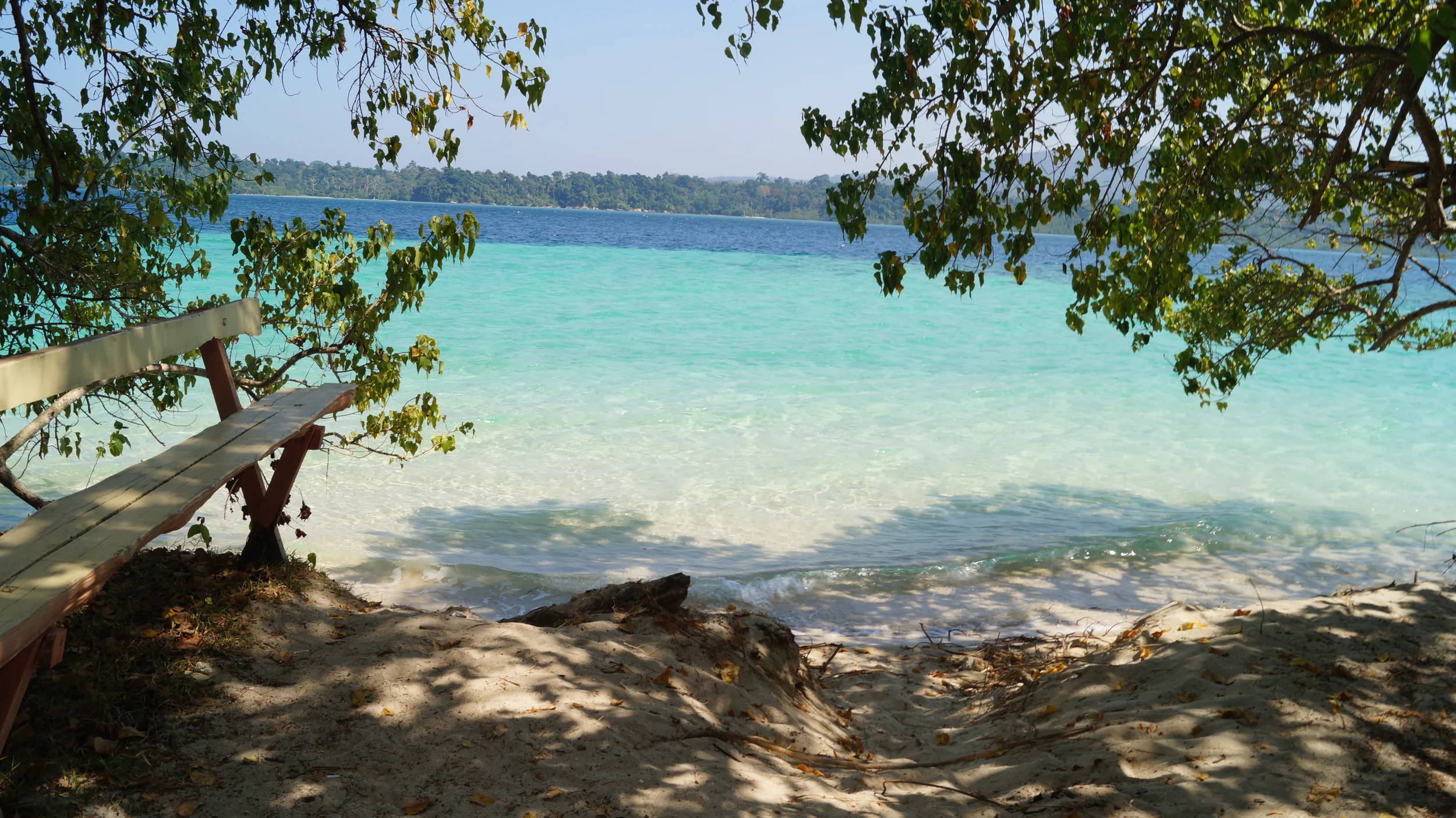
📷 Clear shallow water and coral reef off Jolly Buoy Island in the Andamans
Ritu Kulshrestha · CC BY-SA 4.0
Jolly Buoy Island
A strictly protected coral island in Mahatma Gandhi Marine National Park, open only half the year — glass-bottom boats, snorkelling and a total ban on plastic.
Quick Information & Logistics
- Location
- Mahatma Gandhi Marine National Park, off Wandoor, South Andaman
- Distance
- ~30 km from Port Blair to Wandoor (~1 hr by road), then 20–30 min by boat
- Open
- Roughly November–May — alternates with Red Skin Island; confirm before travelling
- Permit
- Forest Department permit required; issued at Wandoor
- Activities
- Glass-bottom boat, snorkelling. No scuba, no water sports
- Plastic
- Banned outright — bottles and wrappers are collected at the jetty
- Stay
- None — day visit only, boats return the same afternoon
Overview
Jolly Buoy is a small uninhabited island inside Mahatma Gandhi Marine National Park, and it is the closest thing the Andamans have to a reef kept deliberately out of reach. There are no shops, no shacks, no water sports and nowhere to stay — the island is open for a few hours a day, to a capped number of visitors, for part of the year only.
That restraint is the point. Jolly Buoy and neighbouring Red Skin Island are opened in alternation, one at a time, so that whichever is closed gets months of undisturbed recovery. The result is coral in noticeably better condition than the reefs closer to Port Blair, and it is worth the extra effort to get here.
The alternating season
Only one of Jolly Buoy and Red Skin is open at any time, and they swap over roughly every six months. Jolly Buoy is generally the one open across the drier months, broadly November to May, with Red Skin taking the rest of the year.
Treat those months as a guide, not a timetable. The changeover date is set by the Forest Department and moves; the only reliable check is to ask in Port Blair or at Wandoor a day or two before you plan to go. People do turn up at Wandoor to find the other island is the open one.
Getting there
Wandoor is about 30 km south-west of Port Blair, an hour or so by road — taxis, and a slower government bus, both run there. Boats leave from Wandoor jetty in the morning, and the crossing takes 20–30 minutes.
You need a Forest Department permit, arranged at Wandoor before boarding. Bring photo ID. Boat seats are limited and the day’s trips can fill, so arrive early rather than mid-morning. In rough weather, and through much of the monsoon, sailings are cancelled outright.
What there is to do
- Glass-bottom boat — usually included, and genuinely good here: the coral is dense and the water clear enough to see detail without getting wet.
- Snorkelling — the reef begins close to shore. Gear can be hired at the jetty, though it is worth bringing your own mask if you have one.
- The beach — white sand, shallow water, and a short stretch of shade.
There is no scuba diving at Jolly Buoy, and none of the jet-skis or banana boats you find at North Bay. If that is the day you want, go elsewhere; this island is for the reef.
Practical notes
- Plastic is banned, and the ban is enforced. Bottles, wrappers, and packaged snacks are collected at the jetty before you board. Carry water in a steel or glass bottle, or buy one at Wandoor.
- Take everything back with you. There are no bins on the island because there is no one to empty them.
- Bring cash for the permit and boat; there is no ATM at Wandoor.
- There are no toilets, food stalls or drinking water on the island. Eat before you go.
- Sunscreen washes off into the reef — a rash guard is better than a second coat.
- Do not stand on coral, break it, or take pieces home. Shells and coral fragments are protected inside the national park.
- The last boats leave in the early afternoon; confirm the return time when you buy your ticket.
Nearby
- Red Skin Island — the other half of the rotation, and where the boats go when Jolly Buoy is closed.
- Scuba diving and coral reefs — where to dive, given you cannot here.
- North Bay Island — far easier to reach from Port Blair, with a busier and more developed reef.
Last updated on 22 August 2026. Timings, permit guidelines and schedules are subject to change. Always verify locally before traveling.