

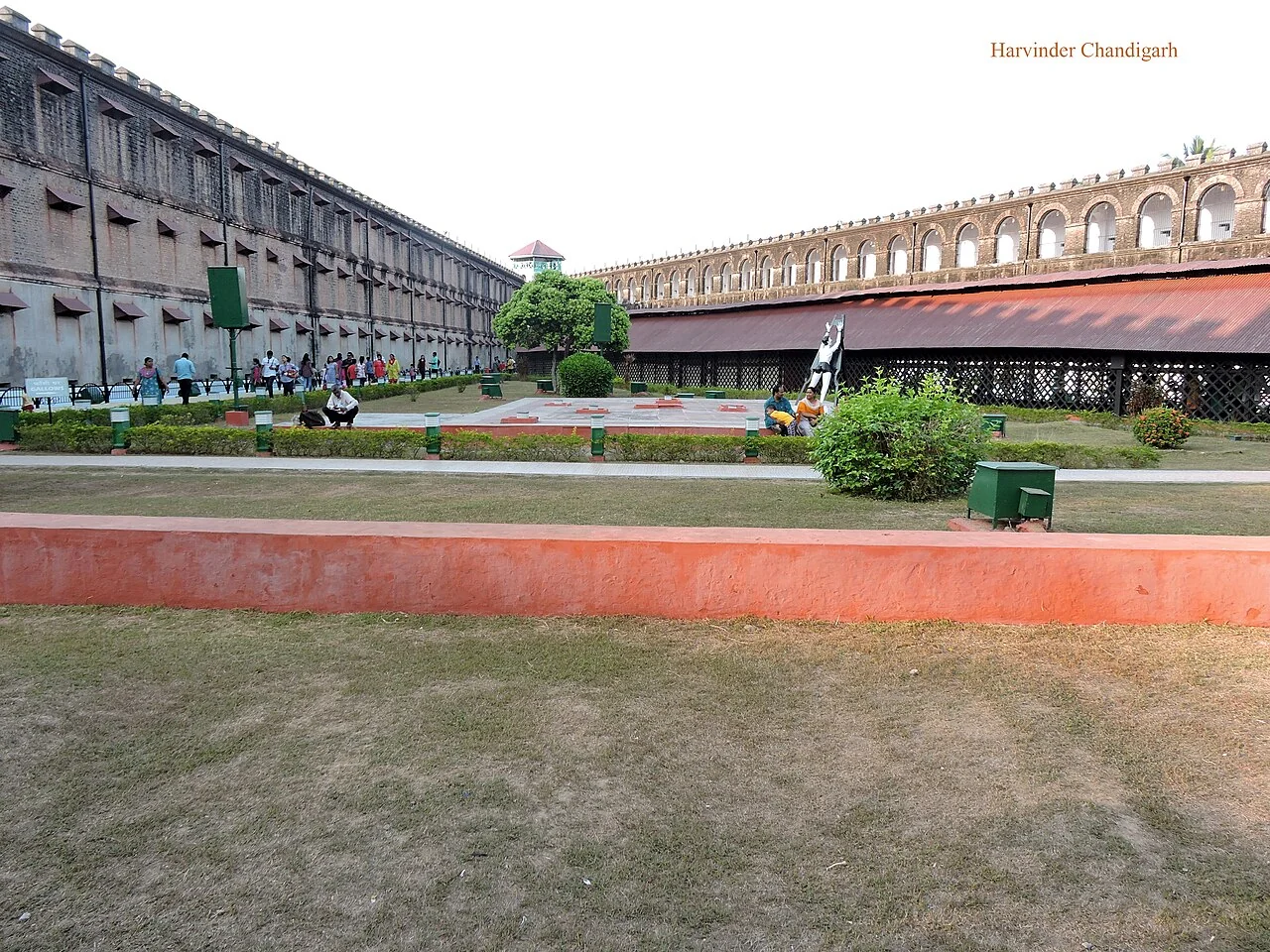
Cellular Jail (Kala Pani)
The colonial prison at the heart of Port Blair — a national memorial to the freedom fighters transported here, with a museum, the gallows and the surviving wings.
Quick Information & Logistics
- Location
- Atlanta Point, central Port Blair — walkable from Aberdeen Bazaar
- Open
- About 9 am – 5 pm, closed Mondays and national holidays; lunch break around 12:30–1:30 (confirm)
- Entry
- Roughly ₹30 Indians / ₹100 foreigners; small camera fee (confirm at the gate)
- Time needed
- 1.5–2 hours in daylight; return for the evening show
- Built
- 1896–1906; 7 wings, 693 solitary cells; 3 wings survive
- Also
- Light & Sound Show every evening — see its own page
Overview
The Cellular Jail is the reason “Kala Pani” — the black water — became a byword for exile in India. Built by the British between 1896 and 1906 to hold political prisoners far from the mainland, it was designed on the panopticon idea: seven three-storey wings radiating from a central watchtower, so a single guard could see down every corridor, and 693 solitary cells built so that no prisoner could see or speak to another. Veer Savarkar, Batukeshwar Dutt and hundreds of others were held here; many died of the labour, the punishments and the hunger strikes.
Three wings survive (the rest were demolished after the 1941 earthquake and the Japanese occupation), and the site is now a national memorial. It is the one thing everyone should see in Port Blair, and it deserves more than the twenty minutes tour groups give it.
Getting there
It stands on Atlanta Point above the harbour, ten minutes’ walk uphill from Aberdeen Bazaar or a five-minute auto. There’s parking outside; the ticket counter is at the gate.
What to see
- The cells — climb to the top floor of a wing and walk the corridor; the cell doors, the tiny ventilators, the view down to the watchtower explain the design better than any plaque.
- The central tower — climb it for the radial view across the wings and the harbour to Ross Island.
- The gallows — the execution shed, preserved with its three nooses.
- The museum and galleries — photographs and records of the prisoners, the punishments (the oil mill, the fetters), the hunger strikes, and the Japanese years. The art gallery and the “eternal flame” of freedom (Swatantrya Jyot) are in the courtyard.
- The Netaji gallery — on the Japanese occupation and Subhas Chandra Bose’s 1943 visit.
Practical notes
- Go early (9 am) or after lunch — coach groups arrive mid-morning and the corridors get crowded and hot.
- The site is uneven and involves stairs; there’s little shade in the courtyard. Carry water; there’s a small canteen and toilets near the entrance.
- Photography is allowed (small camera fee at times); no drones.
- Closed Mondays. Timings and fees shift — check at your hotel or the gate rather than trusting a blog (including this one).
- Guides wait outside; a good one adds a lot. Agree the price first.
- Come back after dark for the Light & Sound Show — a separate ticket, and worth it.
Nearby
Marina Park and the boats to Ross Island are ten minutes downhill; the Anthropological Museum is a short auto ride; Corbyn’s Cove is 15–20 minutes by road for a swim afterwards.
Last updated on 19 August 2026. Timings, permit guidelines and schedules are subject to change. Always verify locally before traveling.